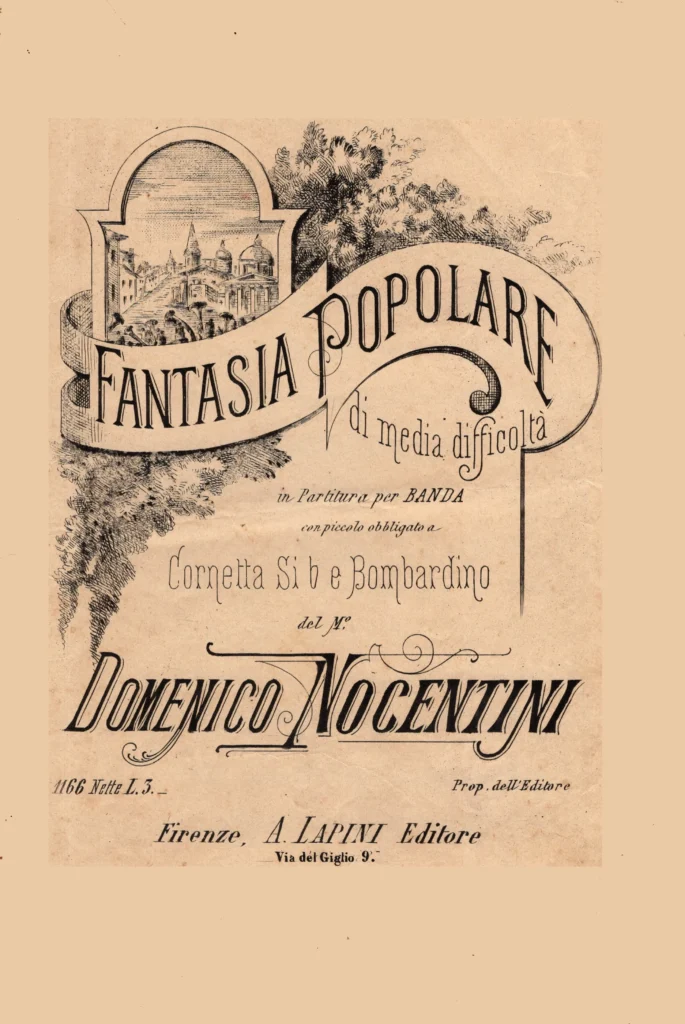



Domenico Nocentini
Italian clarinetist, teacher, composer, and band director (Laterina, March 18, 1849 – Florence, December 29, 1924), Domenico Nocentini was one of the most important figures of the Tuscan clarinet school between the 19th and 20th centuries. His artistic activity spanned multiple fields — concert, orchestral, pedagogical, compositional, and band — making a significant contribution to the evolution of Italian clarinet technique and to the dissemination of original clarinet repertoire.
Education and Early Years
Born in Laterina, in the province of Arezzo, Domenico Nocentini displayed a particular musical aptitude from a young age. He moved to Florence to study at the prestigious local Istituto Musicale, where he attended the clarinet class of Giovanni Bimboni, one of the foremost Italian clarinetists and teachers of the 19th century, and studied organ and composition with Teodulo Mabellini, a central figure in Tuscan musical life of the time.
The Florentine musical environment of the second half of the nineteenth century, characterized by a strong theatrical and orchestral tradition, profoundly influenced his artistic development, orienting him towards a musical writing in which operatic lyricism, virtuosic brilliance and technical solidity coexist.
Orchestral Career
Nocentini embarked on a long and prestigious orchestral career, establishing himself as the first clarinet soloist in the major Florentine musical ensembles. His presence in the city’s theatre orchestras placed him at the centre of Tuscan musical life during a period of intense operatic activity.
He was a member of the Florentine orchestra that would later form the original nucleus of the future permanent orchestra of the Maggio Musicale Fiorentino, the institution founded in the twentieth century by Vittorio Gui.
Given his role in the Florentine orchestral scene, it is highly likely that Nocentini had professional contact with Giacomo Puccini, who regularly attended rehearsals and performances of his operas in the city’s theatres during the clarinetist’s career.
Technical Innovations and Performance Style
Domenico Nocentini is remembered in the Italian clarinet tradition as one of the first performers to consistently use only the B-flat clarinet in the orchestra, employing transposition, a practice that helped modernize and simplify orchestral clarinet performance.
At a time when the use of different clarinets tuned to various keys was still widespread, Nocentini distinguished himself with a more modern conception of instrumental technique. This innovation demonstrates not only his virtuosic qualities but also his remarkable theoretical and practical mastery of the instrument.
His educational compositions also demonstrate a profound understanding of Italian Romantic clarinet technique: articulation, homogeneity of timbre, technical flexibility, and melodic expressiveness are the central elements of his writing.
Teaching Activity
From 1892 to 1921 he served as professor at the Florence Istituto Musicale, carrying out a long pedagogical career that contributed to the education of an entire generation of Italian clarinetists.
Among his most distinguished students are:
- Pietro Gagna
- Alamiro Giampieri
Nocentini’s teaching work occupies a prominent place in the literature on clarinet education. His mechanism and melodic studies, conceived according to the principles of the 19th-century Italian clarinet school, are still studied and adopted today in conservatories, music schools, and academic institutions in numerous countries, contributing to the technical and musical education of generations of clarinetists both in Italy and internationally.
In particular, the 50 Mechanism Studies, the 32 Mechanism Studies, and the 24 Melodic Studies still represent important reference works in the professional training of clarinetists.
Band Activities
Alongside his orchestral and teaching career, Nocentini also played a significant role in the Italian band scene, a key sector in 19th-century musical life.
From 1878 to approximately 1883, he was director of the municipal band of Laterina, contributing to the cultural and musical growth of the area. He composed numerous marches, fantasies, and original pieces for civil bands, a genre that clearly fuses operatic flair, instrumental brilliance, and celebratory function.
Awards and Recognitions
In 1876, he won the competition for the composition of a Concerto for Clarinet and Orchestra, organized by the Academy of the Real Istituto Musicale of Florence.
In 1881, he received another prestigious award for his Symphony for Nine Wind Instruments, likewise honoured by the same institution.
From 1890 onward, he was a resident member of the Academy of the Real Istituto Musicale of Florence, attesting to the prestige he achieved in the city’s musical scene.
Catalogue of Works
Domenico Nocentini’s production includes works for clarinet, orchestral, chamber, piano, choral, theatrical, and band music.
Works for Clarinet
- Original Concerto for Clarinet and Orchestra (1876; ms. I-Fc)
- Concert Fantasy for Clarinet and Orchestra (Florence, Bratti, n.d.)
- Ricordi di Venezia, concert fantasy for clarinet and band (Florence, Saporetti & Cappelli, n.d.)
- Ricordo d’amicizia, concertino for clarinet and band (Portici, Pucci, n.d.)
- 14 Duets for Two Clarinets (Florence, G. Venturini, n.d.)
- 50 Technical Studies for Clarinet (Florence, Lapini, n.d.)
- 32 Technical Studies for Clarinet (Portici, Pucci, n.d.)
- 40 Technical Studies with 20 Additional Melodic Studies for Clarinet (Florence, Lapini, n.d.)
- 24 Melodic Studies for Clarinet (Portici, Pucci, n.d.)
Orchestral and Chamber Music
- Symphony for Flute, 2 Oboes, 2 Clarinets, 2 Horns, 2 Bassoons and Contrabassoon
- Symphony for Orchestra
- Fantasy for Trombone and Orchestra
- Sonata for Piano (1889)
Theatrical, Sacred, and Vocal Music
- Maestro Gaudenzio, operetta in prose and music in two acts (1915)
- Mass for Three Voices and Large Orchestra (unpublished)
- Ricordo del dì 10 novembre 1881 nella Badia fiesolana, scherzo for choir
- Two Litany Verses
- Viene il Signor, song for children with piano accompaniment
Piano Music
- La bella veneziana e la bella romana, two mazurkas for piano
- Onde azzurre, nocturne for piano
Band Music
- Esposizione in Vienna Universale, grand military march for band (1874)
- Piccolo pot-pourri originale per banda (1898)
- S. Venanzio, religious march for band
- Numerous other marches, fantasies, and original compositions for band.
Modern Rediscovery
For many decades the figure of Domenico Nocentini remained little known outside of specialized circles dedicated to the history of the Italian clarinet. Beginning in the 2000s, a major historical and musical recovery project was launched by the publishing house Master Symphony of Laterina, involving the revision and modern publication of his works, edited by Maestro Massimo Picchioni.
This editorial effort has enabled the contemporary dissemination of numerous previously difficult-to-find pieces, contributing to the reappraisal of Nocentini as a central figure in the Italian clarinet tradition between the 19th and 20th centuries.
Among the works republished to date are:
- 24 Melodic Studies
- 32 Mechanism Studies
- 50 Mechanism Studies
- Chi non fa non falla, concerto for clarinet and orchestra
- Labor omnia vincit, symphony for 10 instruments
- Maestro Gaudenzio
- Ricordi di Venezia
- Ricordo d’amicizia
- Fantasia popolare
- Fantasy on the Theme of “The Carnival of Venice”
- Cara memoria
- Dolci carezze
- Onde azzurre
Historical Importance
Domenico Nocentini holds a significant place in the history of the Italian clarinet between the 19th and 20th centuries. His work as a virtuoso, teacher, and composer contributed to the development of the Italian clarinet school during a period of profound technical and aesthetic transformation.
His compositions today constitute a precious testimony to the post-unification Italian instrumental tradition, characterized by the combination of operatic lyricism, virtuosic brilliance, and a growing focus on modern clarinet technique. The continued presence of his studies in the curricula of international conservatories and music academies confirms the relevance and pedagogical value of his work.
Bibliography
- Adriano Amore Riccardo, Il clarinetto in Italia. Storia, organologia, letteratura e virtuosi, Frasso Telesino, 2021, pp. 109, 119, 121, 215, 228, 257–258.
- Studies, reviews, and research by Massimo Picchioni on the life and works of Domenico Nocentini.