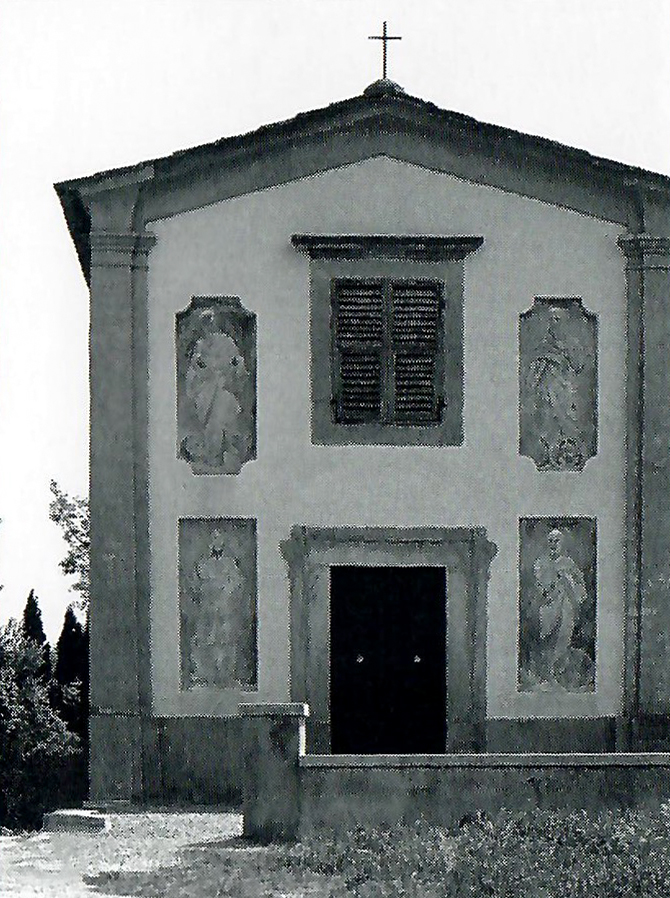



The rural settlement preserves an elliptical layout of medieval origin, indirectly documented by the toponym (from the Latin vetulus, meaning old). The local church, dedicated to San Bartolomeo and a suffragan of the Laterina parish, was rebuilt in the 18th century, most likely by the Busatti family.
The facade, framed by two Tuscan pilasters, features a trabeated portal surmounted by a rectangular window. Within four panels, the Evangelists were originally depicted, though these are now almost entirely lost. Inside, the single nave is adorned with composite pilasters that support the arches of the lowered barrel vault.
The presbytery is covered by a depressed dome, decorated with a depiction of the Virgin surrounded by angels, while the pendentives feature the four Evangelists. These paintings, of mediocre quality, date back to the early 20th century.
The main altar is adorned with two composite columns made of stucco, marbleized, with gilded capitals. The broken and arched pediment, rotated in relation to the rear wall, is crowned by two angels framing the central panel, which depicts the Holy Spirit as a dove.
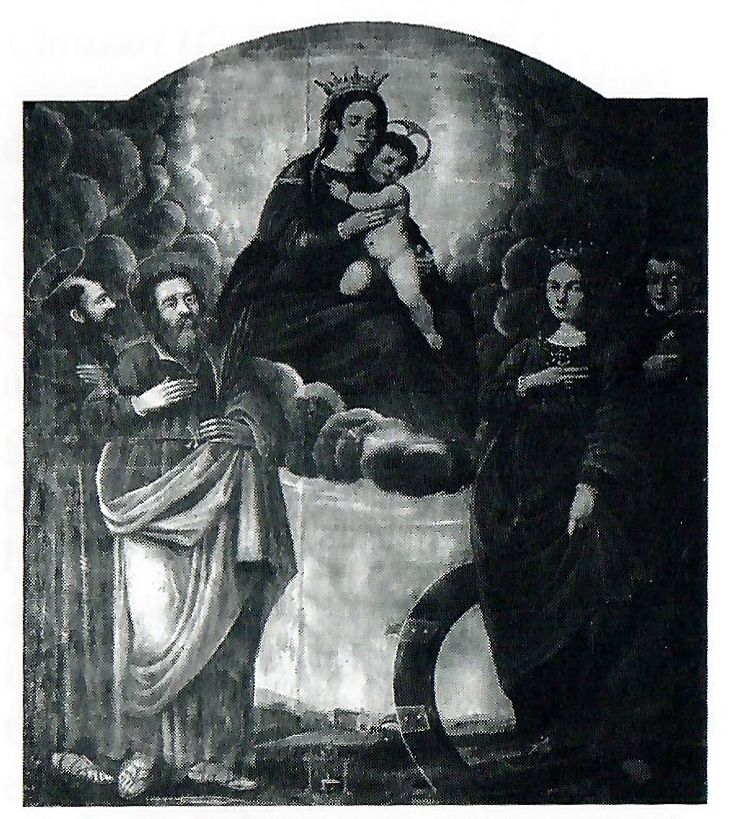
The 18th-century painting depicts the Madonna with Child, surrounded by Saints Francis, Bartholomew, Catherine of Alexandria, and Bonaventure, topped by a stucco cartouche with the inscription “Matri Dei et Sancto Apostulo Bartolomeo dicatum” (Dedicated to the Mother of God and Saint Apostle Bartholomew). The altar has three steps in the Roman style. The two side altars, whose mensas were removed in the 1960s, have capitals similar to those of the main altar, adorned with festoons on the bell-shaped section, supporting broken triangular pediments. The right altar, originally dedicated to the Immaculate Conception, features a painting of the Madonna of Seven Sorrows. Between 1913 and 1935, Father Dario Maraghini carried out restoration work on the church.
To the right of the church stands the former chapel of the Confraternity of Our Lady of Sorrows, originally covered with a gabled roof that collapsed in the mid-1980s.