


We can begin our journey by exploring the area located between the banks of the Arno River and the road that connects Arezzo to Fiesole, particularly the region between Ponte Romito, Laterina, La Penna, and Rondine. This area is now known as the Strada dei Setteponti, which follows the ancient Etruscan route Cassia Vetus, built by the Roman Emperor Claudius in 123 AD to allow merchants and pilgrims to reach Rome. Later, during the reign of Emperor Hadrian, between the 2nd and 4th centuries AD, the route was further developed and connected transversally, crossing the left bank of the Arno River. The original crossing of the river was aligned with the settlements of Ponticino, Impiano, Casa Riccia (on the left bank), Le Pievi, Il Vallino, and Monsoglio (on the right bank).
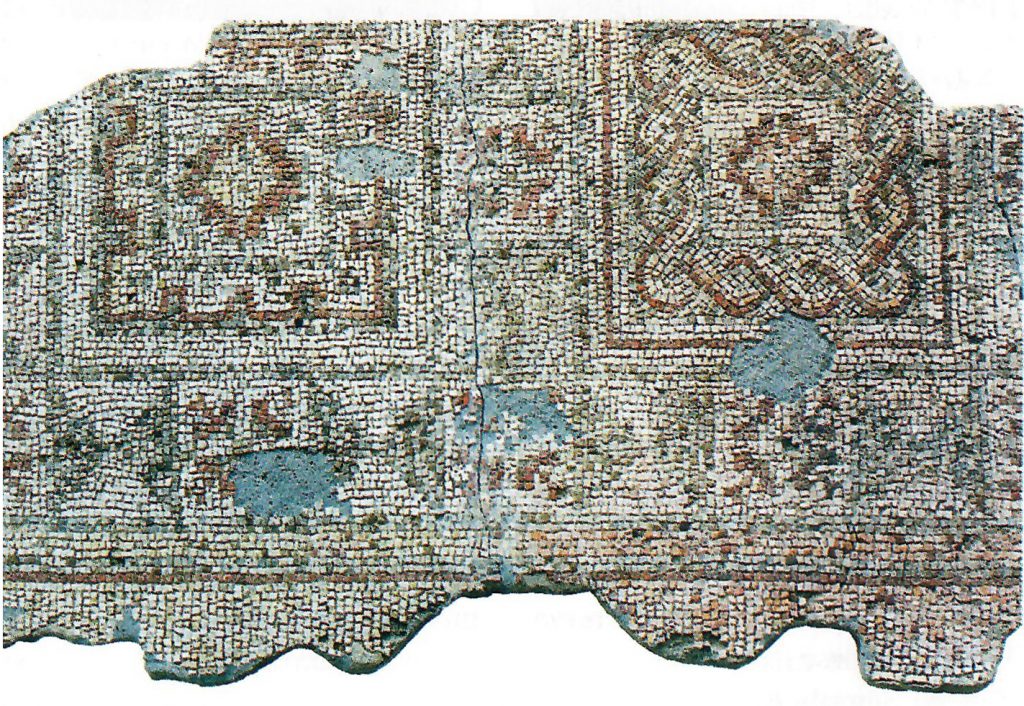
In the direction of the Arno crossing (near the current location of Le Pievi), a Roman villa from the Imperial era had been established, where polychrome mosaic floors featuring geometric patterns dating back to the 4th century were discovered. These mosaics are now displayed on the external right longitudinal wall of the Propositura of Saints Ippolito and Cassiano in Laterina.
The area was characterized by cereal cultivation and livestock farming, and thanks to the connection to San Giustino and Ponte a Buriano, it facilitated activities such as the commercialization of terracotta products made by local kilns that exploited the nearby clay deposits.
On the left bank of the river, in the area of Casa Riccia (where the remains of a dam have been found), we can identify the continuation of the original Roman connection. Around this route, rural settlements like Caianello, Poggio Tondo, Ganascione, and Rimaggio were centered, particularly near Impiano.
In the Pian di Laterina (originally called di Valle, mainly corresponding to its southern extension along the Arno, or di Campavena, referring to its development to the north of the river), numerous secondary streams and some ‘islands’ were formed, which are still reflected in various toponyms today, such as L’Isola, Pieve Vecchia dell’Isola, Isola di Campavena, Spedale dell’Isola, or Isoletta, Longoia, and la Lama.
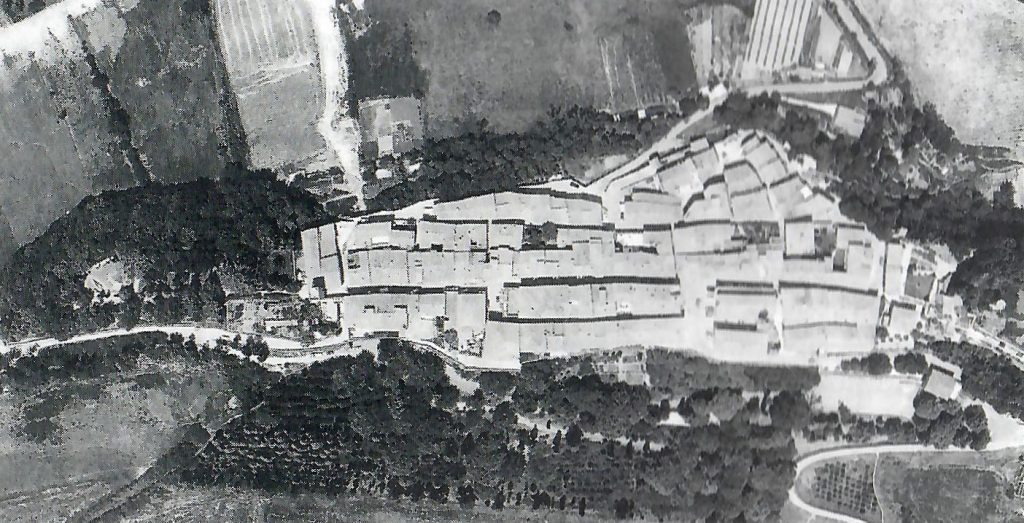
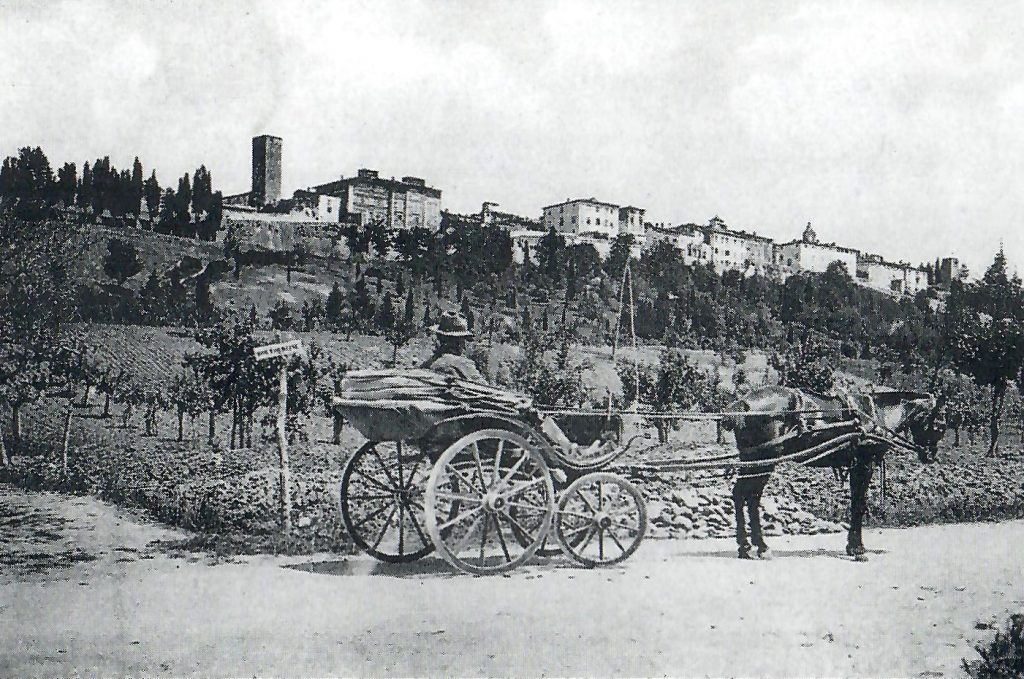
For these reasons, and for security purposes in the event of wars, the Laterini Castle was built by the Ubertini family, nobles of Germanic origin and lords of the area. The castle was constructed on the eponymous plateau of Pleistocene origin, strategically positioned as a balcony overlooking the valley, between the Oreno and Bregine streams, both of Etruscan origin (the first known document dates back to 1014, although tradition traces the founding of the walled village to 962). This is where the village of Laterina began to take shape.
Each “village” that settled had its own small church, dedicated to the same saint as the one in the original settlement: a custom that we will also find in the later and newer communities along the Strada dei Setteponti and in the Florentine-founded “Terre Nove” or “Terre Murate” of the 13th and 14th centuries.
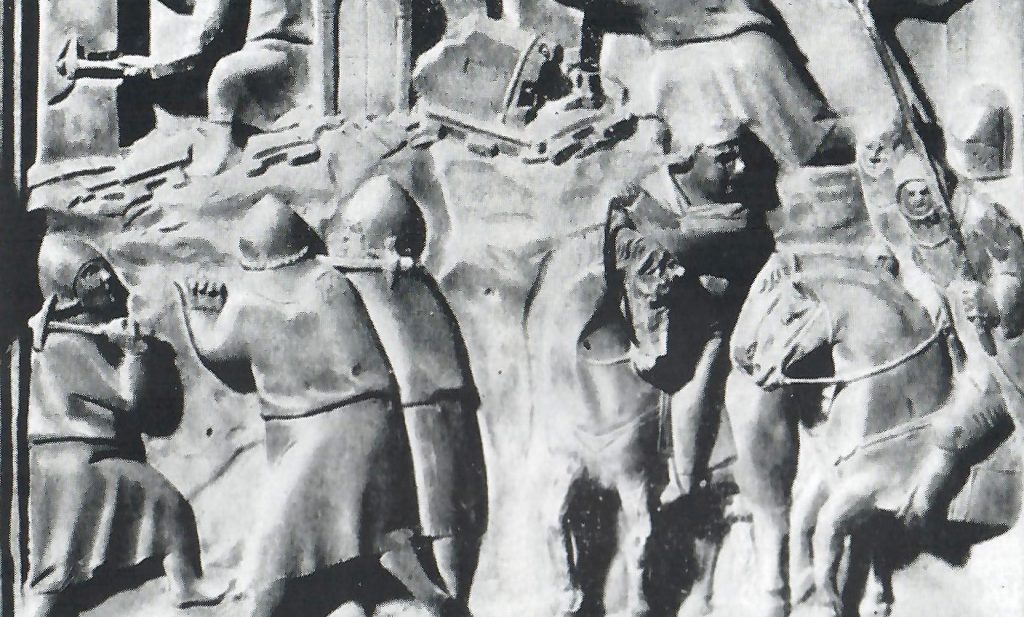
In 1288, during their war against Arezzo and the Ghibelline nobles of the countryside, the Florentines captured and destroyed several castles belonging to the Ubertini family, including the Rocca di Laterina. This castle was destroyed and rebuilt several times during the battles. It was only a decade later, in the early 1300s, that the Rocca was fully rebuilt. The final clashes occurred in 1341 and 1347, further solidifying the turbulent history of the castle.
By now, the main route between Florence and Arezzo had become the one that, coming from Figline, the “new town” of San Giovanni (founded by the Florentines in 1299), and Montevarchi, crossed the Arno at Ponte Romito and passed by Laterina. From then on, the old road section between Monsoglio and Le Pievi gradually lost its importance. The earliest statutes we have from the Municipality of Laterina date back to 1362, and were subsequently renewed several times during the 14th and 15th centuries.
In 1384, Arezzo passed definitively under Florentine control, and Laterina, consequently, was permanently incorporated into the territory of Florence, initially experiencing a gradual decline. The pre-existing Borgo Maestro, located in a median position, not centrally but shifted towards the rebuilt and expanded Rocca, expanded into the square with the Romanesque church – which would later become the parish church – and the public building of the Podestà or the Vicars along the northern side, flanked on the left by the grain loggia.
The civil and military government of Florence was exercised through a podestà (documented as early as 1354) and a captain. In that century, following the tradition of the Mendicant Orders, which had already been codified during the 13th century, some Dominican friars founded a “hospital” in Laterina, which was later ceded to the Municipality in 1451 (it was located on Via dello Spedale, near the current municipal building, corresponding to the Migliorini townhouse). Other extramural hospices were managed, perhaps from that time, by Franciscan friars; however, numerous properties still belonged to the Benedictine abbey of Agnano. No significant Franciscan, Dominican, or Augustinian convents, however, were established in the territory of Laterina, highlighting the marginality of the area during that century.
The main fresco decorations in the churches of the Laterina area date back to the mid-15th century, along the Aretina main road (in the intramural parish church, in the oratories of San Bernardino and Madonna della Neve, and in the church of San Pietro at Casa-nuova).
Among the emerging families in the village, we can mention the Pasquini family (which became extinct in the mid-19th century). Among the religious institutions, the one with the most real estate was represented by the parish church, which owned numerous “scattered” lands as well as the estates of the Spedale dell’Isola and the Pieve Vecchia dell’Isola.
Also, some Florentine families, staunchly Guelph in faith, had started to ‘recolonize’ the territory as early as the previous century, now freed from the old feudal servitudes (consider the Peruzzi family in the former castle of La Penna and later in Monsoglio).
During the 16th century, the urban and commercial life of Laterina centered around the Piazza dei Vicari and the Borgo Maestro; religious life revolved around the lay confraternities. In 1576, there were three lay confraternities: the one dedicated to the Madonna or the SS. Annunziata, which had been documented as early as 1533 (the oratory was created in the ancient church of Sant’Andrea di Ghianderino), the penitential confraternity of Santa Croce and Santa Maria Maddalena (founded in 1419), and the confraternity of the Corpus Domini (established during the Counter-Reformation – existing since 1552 – which later took the church of San Biagio as its seat).
In 1842, there were six grocery stores, two blacksmiths, two carpenters, four cobblers, a greengrocer, a barber, a café in the square, and two public ovens in Laterina. Many women were involved in straw hat production at the factory established by Marquis Ginori, one of the area’s largest landowners.
In the estate of the Pieve dell’Isola (in the area of Le Pievi), there was “the workers’ house,” a wine press, a granary, and a tower, part of which was used as a dovecote, near the old Piazza della Chiesa and the surviving cloister.
In the second half of the 19th century, the main square was partially demolished and opened up to overlook the Arno valley below, offering a stunning panoramic view towards the hills of Ponticino and Pergine.