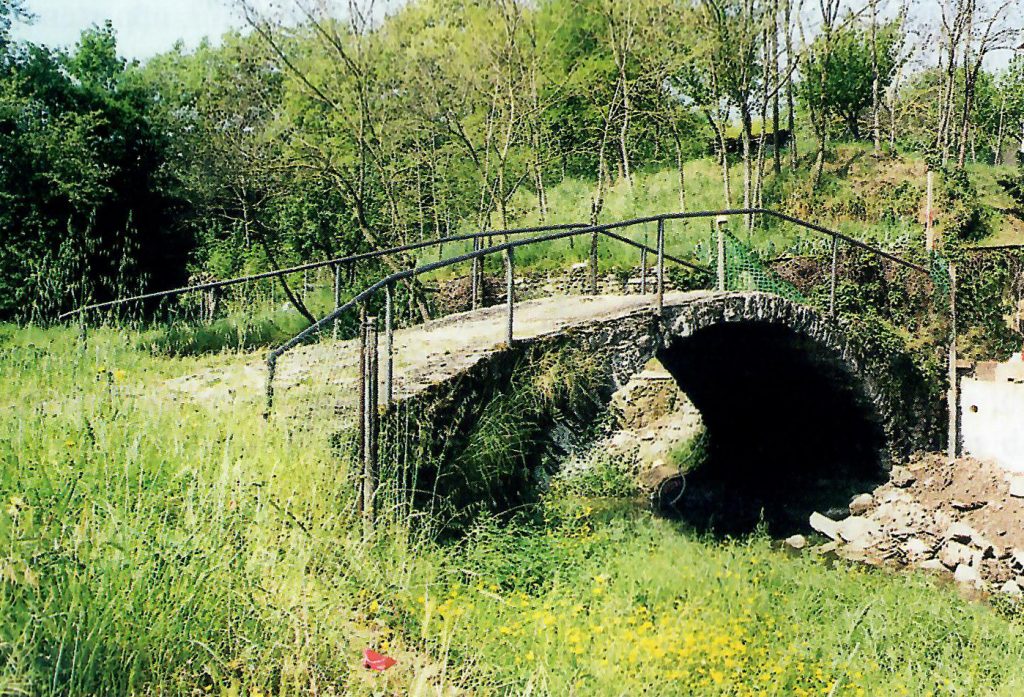



The toponym Tornaia originates from an ancient “ponticino” (small bridge) built across the Ganascione stream as early as the medieval period. This area served as the core of an urban settlement (an ancient “mercatale,” or market town, that developed from a lower area). The name Tornaia refers to a “group of houses,” possibly of Lombard origin, and is documented as early as 1049. Around 1070, a Benedictine monastery was established here, which existed until 1109. According to tradition, a castle was built at the site in 1273. This castle belonged to the Castro family in the 14th century and later to Duccio del Ciullo in the 15th century, but it was destroyed in 1527 by the Lanzichenecchi (the mercenary troops of the Holy Roman Empire during the Italian Wars).
In 1770, a chapel dedicated to Santa Maria, known as “Il Chiesino,” was built on the site, but it was demolished in 1985. In its place, there is a modern sculpture depicting the Virgin with Child, created by Francesco Sordini (1986).
The name “Ponticino” first appears in the 15th century, in the land registers of the Abbey of Agnano, a location where several buildings are first documented around the mid-16th century (a posting station and an inn, built near the bridge, which was rebuilt in 1526).
The urban development of Ponticino, however, began only at the end of the 18th century, with the construction of the new route of the Via Aretina. This development increased in the post-unification period with the arrival of the railway (1866) and the subsequent construction of the small station.
In 1918, the parish headquarters was transferred from Impiano to Ponticino, retaining its dedication to Saints James and Christopher, in the renovated building of a sawmill. In 1924, the “Parco della Rimembranza” (Remembrance Park) was opened in front of the church, and the following year, on Via della Casaccia, the “Forza e Mente” recreational center was inaugurated: a building with a theater, a game room, and a ballroom, originally featuring a large architraved arch and two central columns on the façade (today, it houses a multi-purpose cultural center).
In 1958, the new bell tower of the church was built, now dedicated solely to Saint James the Greater. This sacred building was last partially reconstructed in 2000, based on a design by architect Mariottini of Arezzo. Inside, the sober interior is dominated by the large presbyterial cross, and it houses two modern paintings: one depicting Saint James the Greater, by Roberto Meschini, and the other of the Annunciation, by Franco Fedeli.
In 2001, architect Giuseppe Cencini designed an environmental redevelopment plan for the area around the old “ponticino” (little bridge).