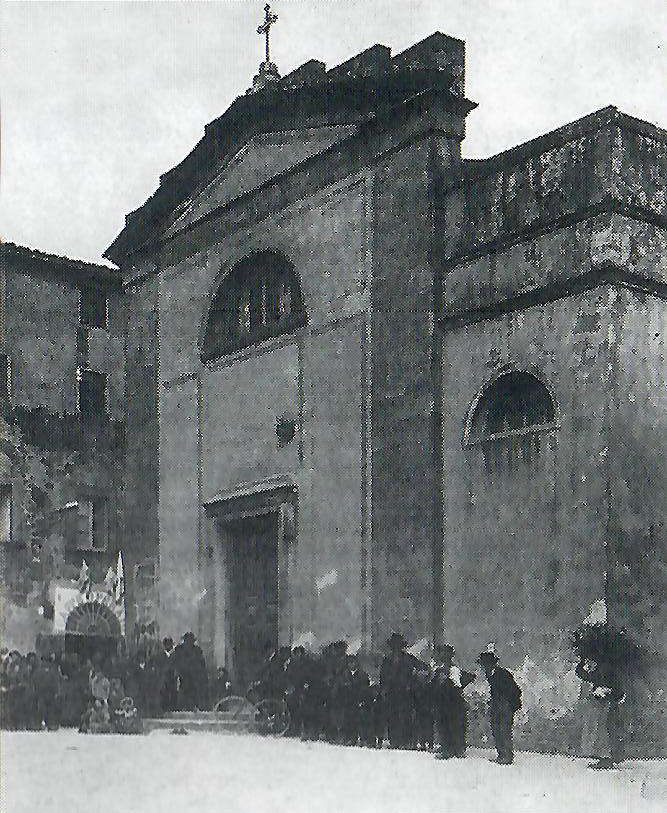



The small church, located at the corner between Piazza del Popolo and Borgo Maestro, played an important role in the religious and social life of the Laterina community. It was established by the “people” from the valley, originally dedicated to Santa Maria, at the end of the 12th century, when the population from the valley moved into the castle of Laterina. The church was given the title of Pieve, currently the Propositura of Saints Hippolytus and Cassian in Campavena.
Previously, this title was assigned to the original church, located on the right bank of the Arno to the southwest, near the current area of Le Pievi. The church was built on the site of a late antique Roman villa-farm that was destroyed, and mosaics were found here, now displayed in the current Propositura of Laterina.
Today, in addition to being a center of prayer and devotion for the local faithful, the church serves as a place of gathering and celebration for the town’s religious and civil festivals. Inside, it features numerous frescoes, including The Madonna with Child between Saints John the Baptist and Sebastian, and Saint Francis receiving the Stigmata.
Tracing the history, during the 13th century, the church was essentially rebuilt in Romanesque style. The building, which in the 1302-1303 tithes is recorded as having one of the largest parishes in the Valdarno, with sixteen subsidiary churches, was oriented along an east-west axis. It had a single nave, 18 meters in length and 9 meters in width, with walls made of sturdy stone blocks arranged in regular rows, two lintelled doors surmounted by lunette windows (the main one facing west, the other facing north), a gabled roof supported by four trusses, and a brick floor with numerous burials. In addition to the main altar (likely within a semi-circular apse), there may have been two side altars, one of which was dedicated to Mary.
Around the mid-15th century, the presbytery was rebuilt with a rectangular plan, featuring a large single-window with double jambs, and the nave was extended. In the added section (which also involved the reconstruction of the facade), two niches with a lowered-arch design were created: one on the left, where The Madonna with Child between Saints John the Baptist and Sebastian was frescoed, and one on the right, which originally depicted a perspective loggia with several figures of saints (now no longer extant).
To the right of the portal, on the counter-façade, was painted Saint Francis receiving the stigmata; in the background, the plain traversed by the Arno River was depicted. At that time, the church likely had a small bell tower. A bell, dating back to 1431 and featuring images of the Savior, the Madonna with Child, and Saint Michael the Archangel, belonged to the community of Laterina. An inscription on the bell read “honorem Deo et patriae libertatem” (“honor to God and freedom for the homeland”).
By 1578, there were fifty-four burials in the floor of the church, in addition to those in the small hospital of Santa Maria within the church walls, as well as the tombs of the parish priests.
Around 1585, after the northern door was closed, a new altar dedicated to the Madonna del Rosario was built, where in 1587, a painting by Cosci was placed, commissioned by the local Compagnia del Rosario and San Giuseppe. A new door was also opened to the south, leading to the external cemetery, and a pulpit was installed. In 1694, Ippolito Maria Busatti (parish priest from 1674 to 1707) had a new bell cast for the small bell tower, and in 1697, he provided the main altar with a polychrome scagliola paliotto (altar frontal).
In 1706, the parish priest of the church of San Bartolomeo in Vitereta, Giovan Battista di Giovanni Busatti (from one of the wealthiest and most prominent families of Laterina), had two Baroque altars in stucco built in the aforementioned 15th-century niches. The altars were dedicated to Saint Francis Xavier (on the left) and Saint Anthony of Padua (on the right). Near the presbytery, to the right, a marbleized wooden choir loft was constructed, housing a five-register organ donated by Busatti himself.
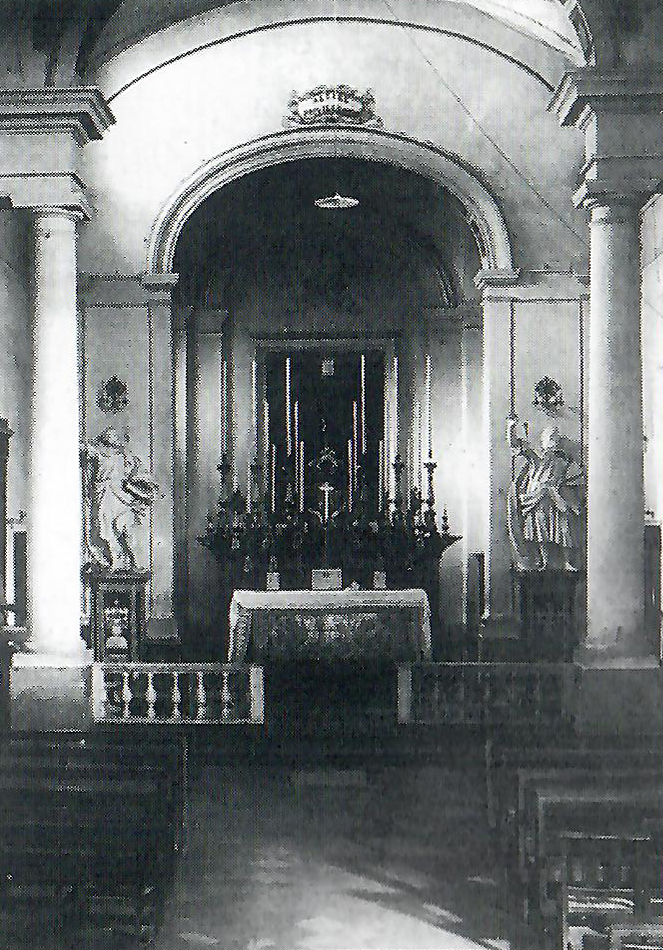
It wasn’t until 1727 that the church was consecrated (as noted on the plaque currently in the sacristy), and on this occasion, the parish priest Filippo Guillichini had the high altar reconstructed, placing the painting by Puligo depicting the Virgin Mary between Saints Hippolytus and Cassian. The walls were decorated with an imposing Corinthian order, and two rectangular windows were installed. A new baptismal font was also created, along with two colossal stucco statues, gesturing and representing Doctors of the Church.
Around 1585, after the northern door was closed, a new altar dedicated to the Madonna del Rosario was created, where in 1587, a painting by Cosci was placed, commissioned by the local Compagnia del Rosario and San Giuseppe. A new door was also opened to the south, leading to the external cemetery, and a pulpit was installed. In 1694, Ippolito Maria Busatti (parish priest from 1674 to 1707) had a new bell cast for the small bell tower, and in 1697, he provided the main altar with a polychrome scagliola paliotto (altar frontal).
Around the same time, a podestà of Laterina named Chiostri had an altar dedicated to Saint Mary Magdalene built along the left longitudinal wall. This altar was adorned with a painting depicting the Crucifixion between the two Mourners, with Mary Magdalene at their feet. Since 1730, the church had been connected to the parsonage by an elevated arched passage.
Following the Leopoldine suppressions of lay confraternities, the Confraternity of the Holy Crucifix was also closed in 1785. Its sacred and miraculous image was transferred to the parish church, where a new altar was constructed in place of the previous one dedicated to the Souls in Purgatory.
In 1800, the provost Ippolito Rossi (from the family that had inherited the considerable properties of the Busatti family) had the facade and counter-facade of the church renovated, adding several mural paintings. In 1842, Don Luigi Luciani, who had been the provost of Laterina since 1832 and had already renovated the rectory in 1836, began the reconstruction of the church, a project that had been envisioned as early as 1838. A first, more modest design for the project had been drafted in 1840, commissioned by Leopold II, by the district engineer Rinaldo Fossi (known 1826-1860), who served as a second-class engineer in Montevarchi from 1840 to 1845.
The new plan for the expansion and reconstruction was developed by the engineer Luigi Chiostri of Laterina (known 1801-1843), who had previously created some cadastral maps of the community of Laterina in 1824, and had worked in the direction of the Corps of Engineers for Water and Roads, serving as a third-class engineer in Montevarchi until 1839. The work was completed in 1843, and in June of that year, the church was reconsecrated (the inscription is currently in the sacristy).
The decorative paintings were executed by Benedetto Ponzi and Pietro Marrabini. The building was regularized and extended to a length of twenty-two meters, with an increased height of about two and a half meters. The façade featured a stone portal with a trabeation in pietra serena, a semicircular neoclassical window, two painted, fluted Tuscan columns, and depictions of the emblems of the two patron saints along with the Eye of God.
Internally, the longitudinal walls were divided by four Tuscan semi-columns supporting the trabeation and the reinforcing arches of the lowered barrel vault. Three arches in the right wall led to the adjacent chapel of the Holy Crucifix, which also had a semicircular window and internal Tuscan semi-columns. This chapel was built at the expense of the newly founded Confraternity of the Blessed Sacrament and the Crucifix, specifically to house the miraculous image (see separate entry), and was conceived as early as 1824.
Along the left longitudinal wall, three altars were erected: those of Saint Anthony of Padua, the Madonna of the Rosary, and Saint Francis Xavier, the latter with a painting depicting the saint, created by Gaetano Cannicci, a pupil of Pietro Benvenuti. The presbytery area was enclosed by a Serlian arch with Tuscan columns and pilasters. The presbytery itself, with the choir behind, featured a vaulted ceiling with a depiction of the Holy Spirit as a dove. The high altar was crowned by a beautiful carved wooden ciborium.
In 1845, the organ maker Giovanni Banci of Castiglion Fiorentino built a new organ with twenty-two registers, which was completed in 1848 and placed on the wooden choir loft in the counter-façade. During these works, the 15th-century fresco was whitewashed.
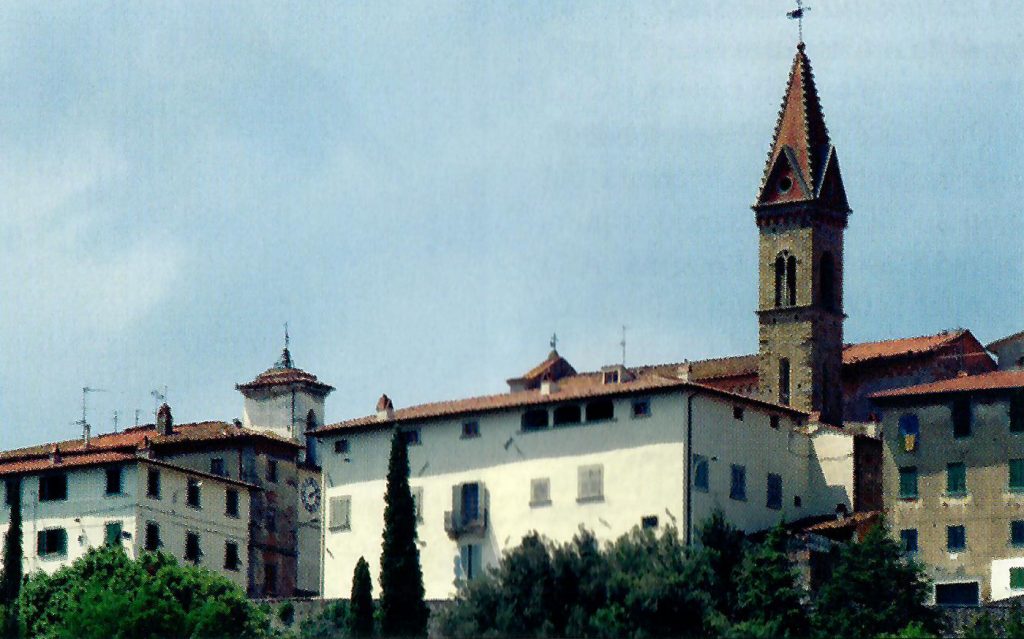
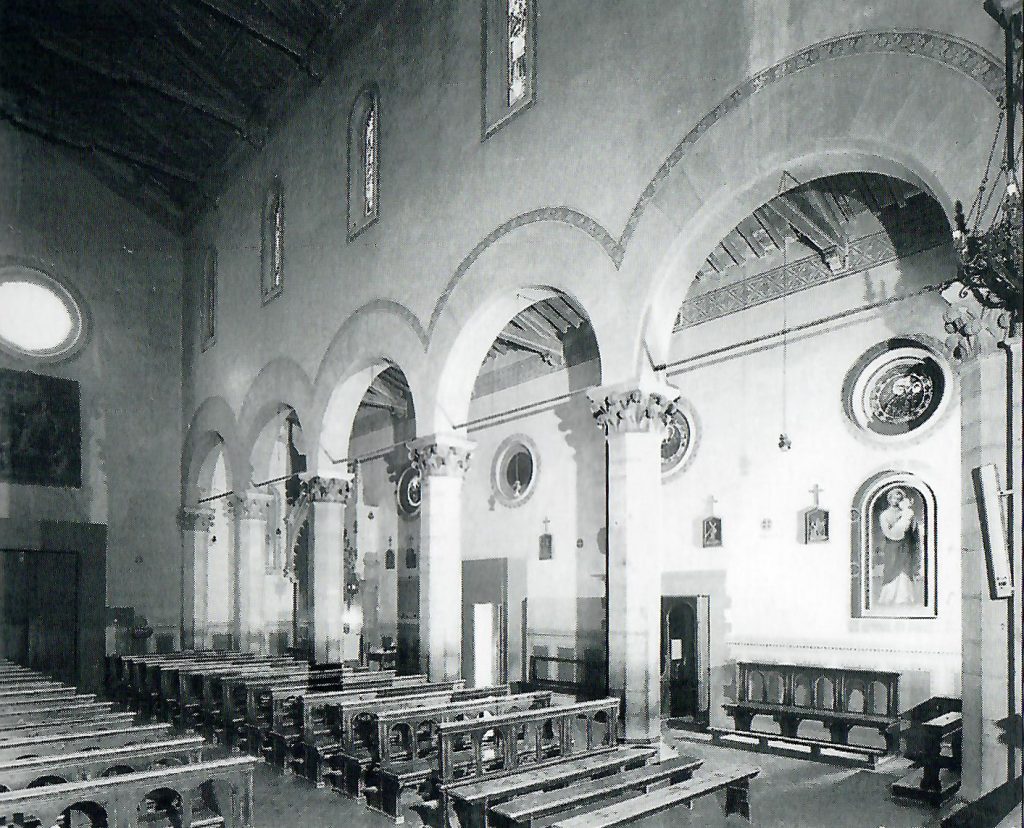
The church was also equipped with a bell tower, a pointed tower 25 meters high, with four bells (one more than before, cast in 1843). Following a violent earthquake in 1919, the church was rendered uninhabitable and had to be reconstructed. Only part of the northern longitudinal wall remained in good condition. The new sacred building, with a basilical plan and three naves, was rebuilt in the 1920s based on a design by the Arezzo architect Giuseppe Castellucci (1863–1939), in neo-medieval style, with octagonal-section pillars and capitals with water-leaf motifs supporting the multicolored trussed roof.
The presbytery, with a rectangular plan, was vaulted in a ribbed pattern and features elegant lateral windows in sandstone. At the end of the right nave is the chapel of the Holy Crucifix, while at the end of the left nave is the chapel of Our Lady of Sorrows, with a statue of the Madonna, purchased in 1931.
The stained glass windows of the single windows, oculi, and the large presbyterial bifora, created in 1928, were designed by the Florentine artist Bruno Masini. The mural painting above the arch of the presbytery, in imitation of Ravenna mosaics, dates from the 1940s and is the work of the Venetian Giovanni Bassan, who also created a San Sebastiano in 1930 for the first altar on the right in the Church of Madonna dell’Umiltà in Loro Ciuffenna, and a San Francesco di Paola for the first altar on the left of the same sanctuary.
During these works, a 15th-century fresco was rediscovered, restored, and enriched with a neo-medieval, polylobed stone pinnacle, crafted by local stonemasons. Externally, the facade is distinguished by a blind arcade crowning, and in the lunette above the portal, there is a terracotta bas-relief depicting the Assumption of the Virgin between angels. Between 1922 and 1923, the bell tower was also rebuilt, with a spire similar to the previous one but taller, once again following the design by Castellucci.