


Pergine is a place with a toponym of Etruscan origin, possibly derived from the Etruscan gentilice Percenas or Percena. This name is also found in another location in Trentino: Pergine Valsugana. Written sources from the Roman era attest to the presence of the population of the Reti in the territory of the central-eastern Alps, including Pergine Valsugana. According to some studies, the language of the Reti is closely related to the Etruscan language.
The territory of Pergine Valdarno boasts a fascinating history that dates back to Roman times, as evidenced by the significant discovery of a metal plate at Poggio Bagnoli, at the foot of the promontory where Pergine stands. This plate features a curse inscription addressed to the water deities, referred to as “aquae ferventes sive ninfas” (the “boiling waters or nymphs”).
The Castle of Pergine is documented as early as 1056, when it was part of the holdings of the Badia di Prataglia in the Casentino, along with its “curtis” (farming estate). This impressive structure was fortified with walls, and in 1154 it was confirmed by Pope Anastasius IV as being under the control of Abbot Sasso of the Badia Agnano, who was likely a member of the Sassi family, which dominated the region at the time. By the 1200s, like many other castles in the area, it came into the hands of the Ubertini family, a Ghibelline family of Lombard origin, who took control of this part of medieval Tuscany after the Sassi.
Towards the end of the 1300s, the town of Pergine, then governed by the Cioni family, submitted to the authority of Florence, following the fate of the Badia di Agnano, to which it was formally subject. It was only in 1586, when Cardinal Carlo Borromeo, then the Commendatory Abbot, renounced his rights over the Badia di Agnano, that Pergine, along with the other possessions of the Abbey, came directly under the rule of Cosimo I. During the 16th and 17th centuries, the town experienced a significant period of growth, with the acquisition of lands and palaces by the Florentine family of the Sestini, who had moved from Settignano to Pergine. Even today, many of the town’s palaces bear the coats of arms of this family.
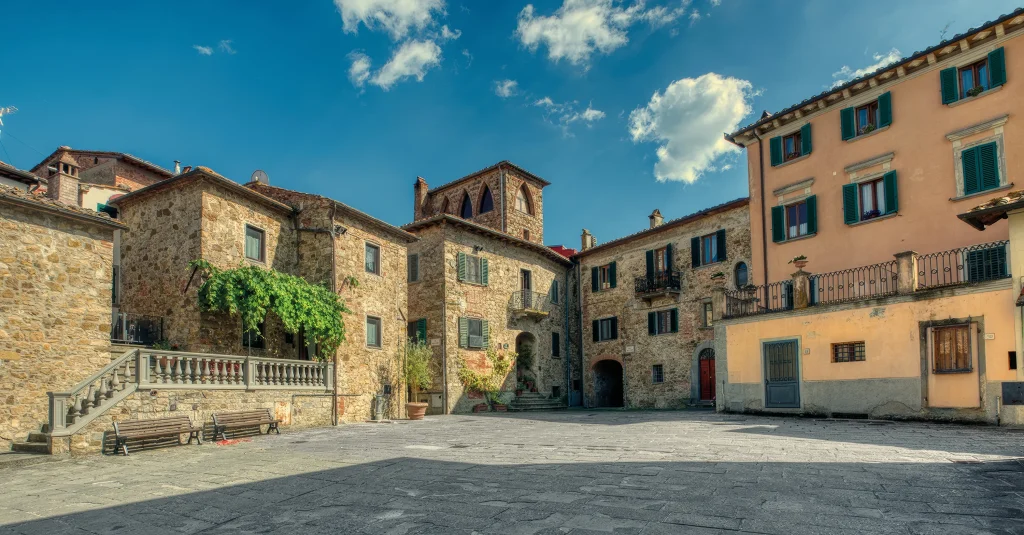
In 1772, during a renovation aimed at modernizing the state, Pietro Leopoldo created the new community of the “Cinque Comuni Distrettuali,” with Pergine as the capital. The other four were Montozzi, Migliari, Badia Agnano, and San Pancrazio. By the 1800s, most of the buildings around the current Piazza del Comune were owned by the Sestini family, one of the large landowning families of the area. The ancient walled village still retains a medieval charm, and you can admire the remnants of the castle towers integrated into the town. The Church of San Michele, first documented in 1200, is also a valuable historical testament still standing today.